The Judgment Lever
A 2x2 for operators working with AI agents. Sort a project before the agent starts: what to hand off, what the agent proposes, the calls you keep and the manual work to shrink.
A 2x2 for operators working with AI agents. Sort a project before the agent starts: what to hand off, what the agent proposes, the calls you keep and the manual work to shrink.
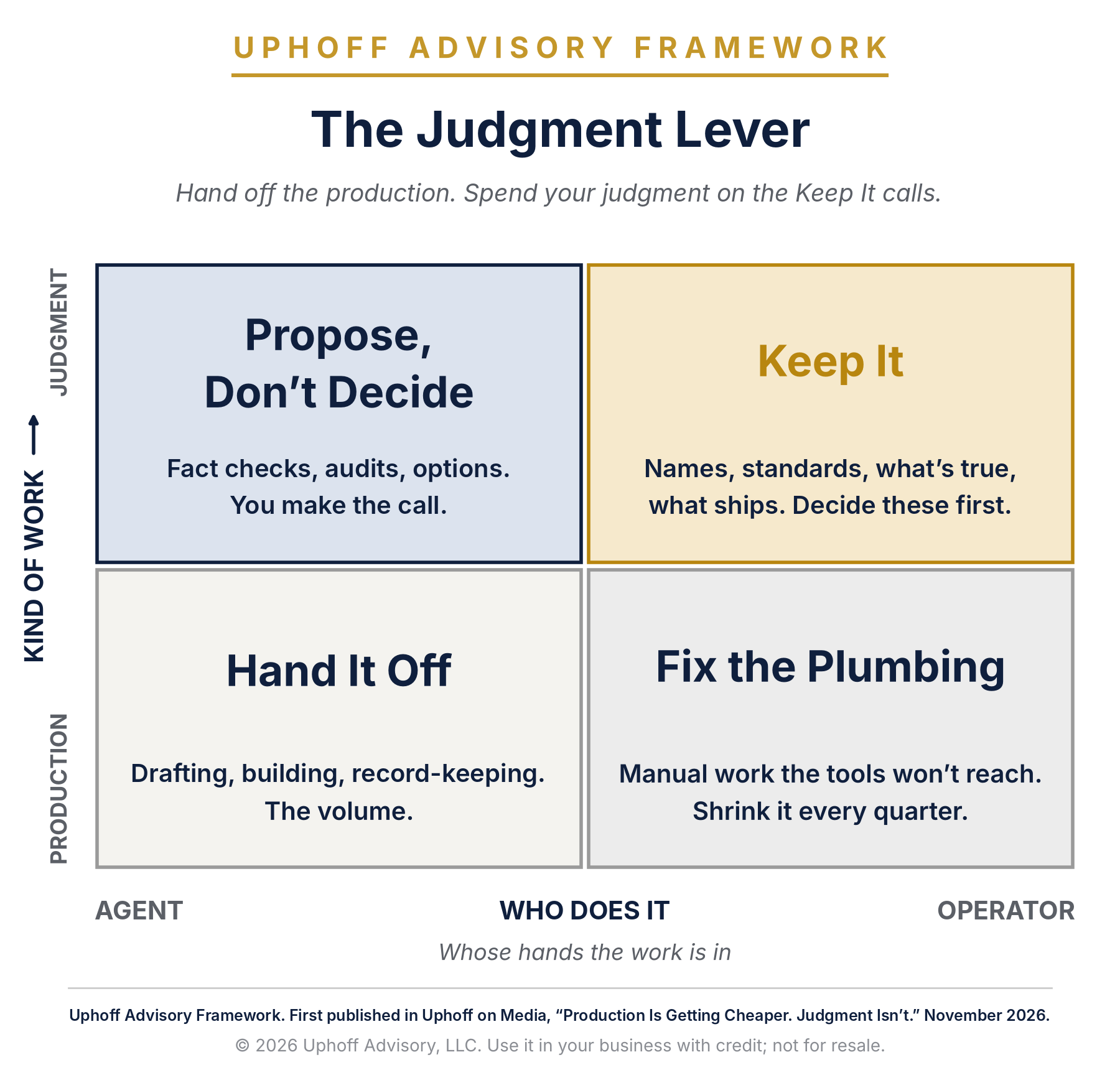
To decide what to delegate to AI, sort the work on two lines before the agent starts: who does it, the agent or the operator, and what kind of work it is, production or judgment. Hand off the production. Let the agent propose, but not decide, on judgment work like fact checks and audits. Keep the calls that define the work: names, standards, what’s true and what ships. Then shrink the manual work the tools won’t reach yet.
List every task in the project before the agent starts.
Production is the volume: drafting, building, record-keeping. Judgment is the calls.
Give the agent the drafting, building and record-keeping.
For fact checks, audits and options, have the agent bring a recommendation and the trade-off. You make the call.
Decide names, standards, sources and what done looks like before production starts. A decision made late is the most expensive hour in the project.
Log your own hours against the four boxes afterward. If most of them sit in Fix the Plumbing, solve that integration problem before the next project.
Finding a problem and deciding what’s true are different jobs. In the build behind this framework, the agent found four published errors. Each fix was a call about what was true, and that stayed with the operator.
Hand It Off: the agent does the production. Propose, Don’t Decide: the agent prepares judgment work and the operator decides. Keep It: names, standards, what’s true and what ships stay with the operator. Fix the Plumbing: manual production the tools won’t reach yet, which should shrink every quarter.
In the build behind this framework, work estimated at about four weeks for a skilled person working alone took nine hours of the operator’s time. The hours are estimates; the order of magnitude is the point.
It is how a Solo Scale operator spends their time. The agents do the volume, and the operator’s judgment is what clients pay for.
Related: Solo Scale and Team Scale; The Scale Multiple Map
The Judgment Lever is an Uphoff Advisory Framework created by Tony Uphoff, five-time B2B CEO and founder of Uphoff Advisory, first published in Uphoff on Media on November 2, 2026.