The Data Moat Test
Plot your data on scarcity and functionality to see whether you own a real moat, a utility play, or an advantage running on borrowed time.
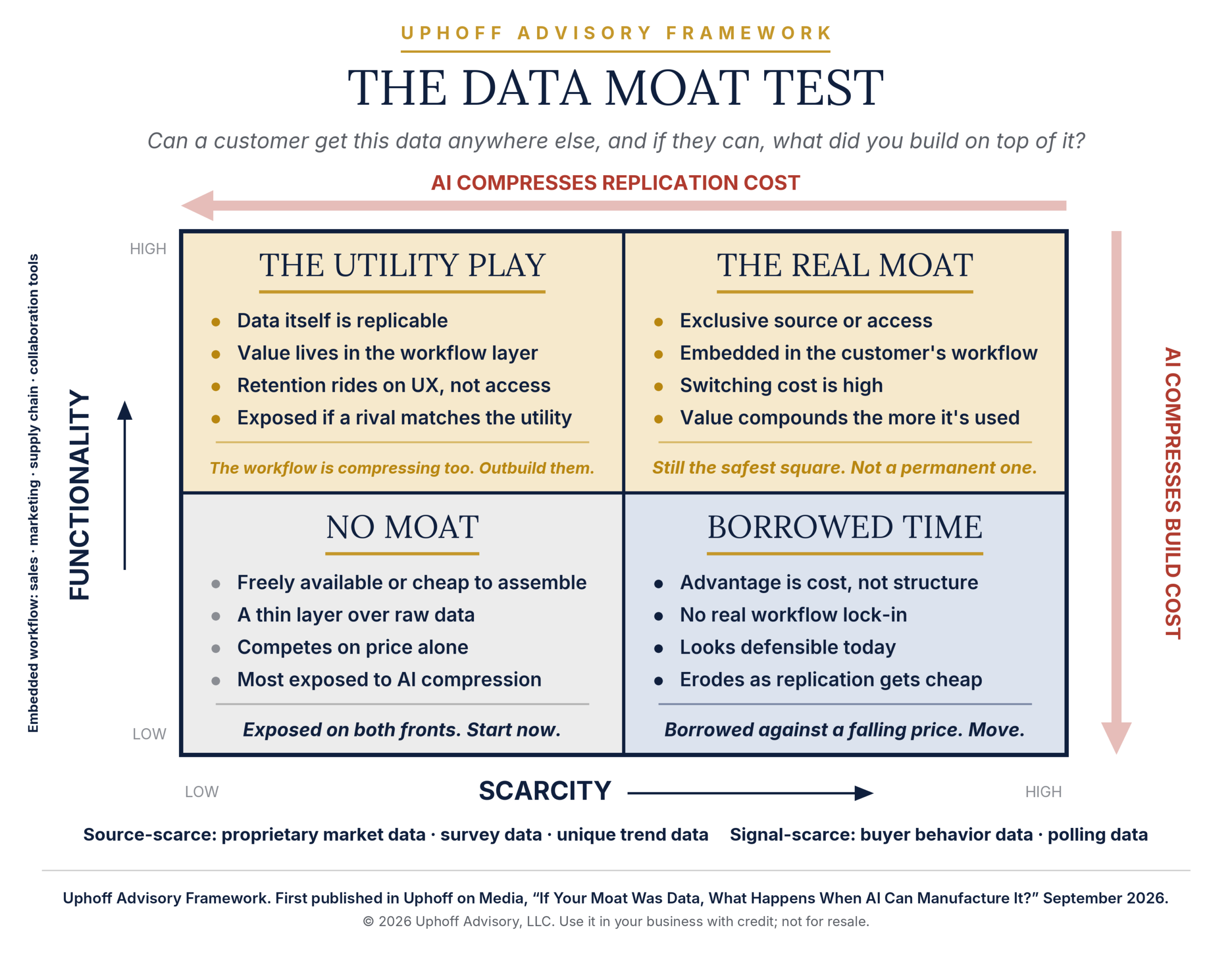
Plot your data on scarcity and functionality to see whether you own a real moat, a utility play, or an advantage running on borrowed time.
The Data Moat Test plots data on two axes. Scarcity asks whether a customer can get this data anywhere else. Functionality asks what you have built on top of it that they would miss. The four squares are No Moat, Borrowed Time, The Utility Play and The Real Moat. The test shows whether a data advantage will hold as AI makes replicating data and building on it cheaper.
AI pushes on both axes at once. It lowers the cost of replicating data, which erodes scarcity, and the cost of building tools, which erodes functionality. Much of what data businesses called scarcity was really cost dressed up as exclusivity, and it held only while assembling the data stayed expensive.
Can a customer get this data anywhere else right now? A real answer is structural, like a relationship, a regulatory position or a physical presence.
If they could get the raw data elsewhere, what have you built on top of it that they would keep paying for?
Score scarcity and functionality separately for each one.
What business outcome does a customer get from you that they can measure, and would you stand behind it in the contract? That answer carries any square into the agentic era.
Data that is scarce because it is costly to assemble, with no real workflow lock-in. It looks defensible today and erodes as replication gets cheap.
No. It is still the safest square, but exclusive access and embedded workflow have to keep compounding to stay there.
Related: The Three Eras of Data Moats · The Durability Test · The Agent Exposure Test
The Data Moat Test is an Uphoff Advisory Framework created by Tony Uphoff, five-time B2B CEO and founder of Uphoff Advisory, first published in Uphoff on Media on September 21, 2026. Read the full piece: If Your Moat Was Data, What Happens When AI Can Manufacture It?