The Signal-Honesty Spectrum
Five kinds of business signal, from form fills to contract value, ranked by how cheap each is to fake. Put every number your leadership team reviews on it.
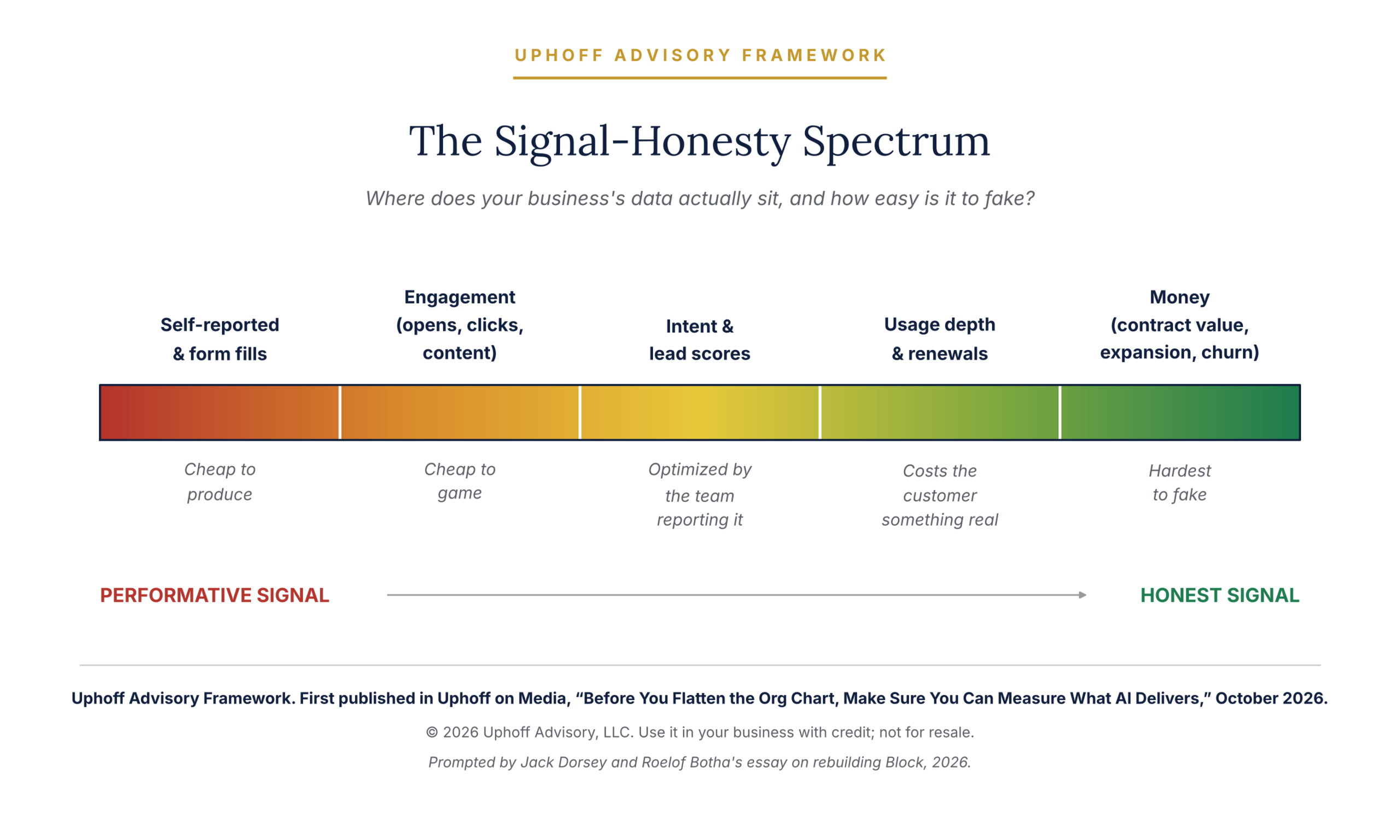
Five kinds of business signal, from form fills to contract value, ranked by how cheap each is to fake. Put every number your leadership team reviews on it.
The Signal-Honesty Spectrum ranks business data by how hard it is to fake. Self-reported data and form fills sit at the performative end. Engagement, then intent and lead scores, sit in the middle. Usage depth and renewals cost the customer something real. Money, meaning contract value, expansion and churn, sits at the honest end.
A lead score isn’t a fact about someone’s business. It’s a fact about how well your content ranks. Before anyone redesigns an operating model or an org chart around AI, the signal underneath has to be honest.
Marketing, sales and customer metrics alike.
Cheap to produce, cheap to game, optimized by the team reporting it, costs the customer something real, or hardest to fake.
That share is how much of your operating picture you can trust.
Before you automate a decision on a left-side number, pair it with one from the right.
Data that costs the customer something real to produce: usage depth, renewals, contract value, expansion and churn.
They are hard to fake outright but easy to optimize for the metric instead of the buyer, often by the same team that reports them.
Related: The Revenue per Employee Ladder · The Borrowed Win Quadrant · The ADAC Stages
The Signal-Honesty Spectrum is an Uphoff Advisory Framework created by Tony Uphoff, five-time B2B CEO and founder of Uphoff Advisory, first published in Uphoff on Media on October 19, 2026. Read the full piece: Before You Flatten the Org Chart, Make Sure You Can Measure What AI Delivers