Two Clocks, Not One
Every disruptive technology runs on two clocks: the technology clock and the market clock. Confuse them and you freeze early or restructure too soon.
Every disruptive technology runs on two clocks: the technology clock and the market clock. Confuse them and you freeze early or restructure too soon.
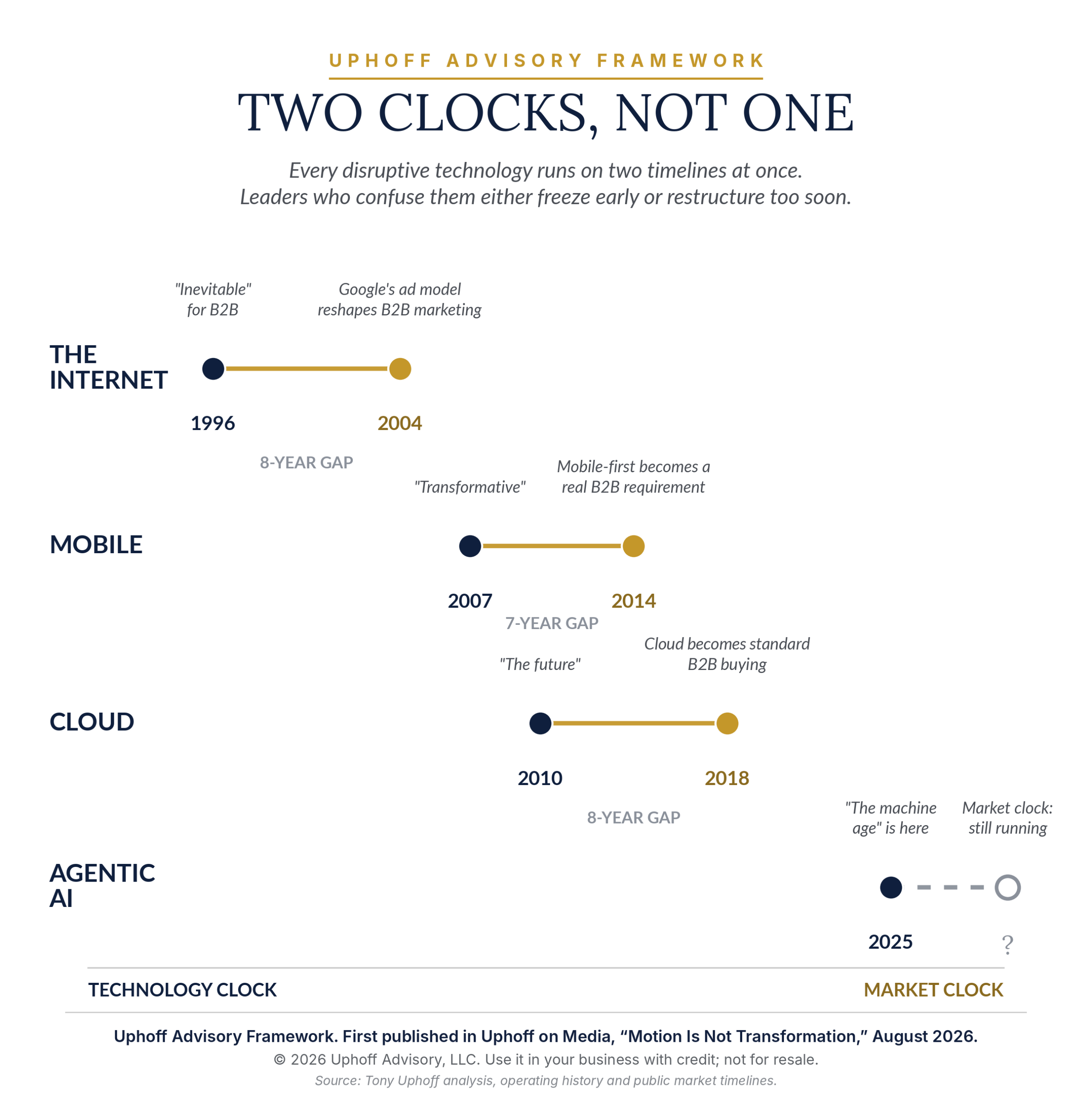
Two Clocks, Not One is a way to decide when to adopt AI, or any disruptive technology. Every one runs on two timelines at once. The technology clock measures how fast the capability improves. The market clock measures how fast buying behavior, business models and organizations actually change. The market clock always runs slower, and leaders who confuse the two either freeze early or restructure too soon.
The pattern repeats. The internet was inevitable for B2B in 1996, and it took until 2004 for Google’s ad model to reshape B2B marketing. Mobile was transformative in 2007, and mobile-first became a real B2B requirement around 2014. Cloud was the future in 2010, and by 2018 it had become the standard way B2B companies bought, even while most of their systems still ran on premise. Each gap ran seven or eight years. Agentic AI’s technology clock is moving fast. Its market clock is still running.
The companies that destroyed value restructured for the technology clock and ignored the market clock. They shut down businesses that still had runway, confusing “this will happen” with “this has happened.” The answer is to invest in capability on the technology clock and manage existing revenue on the market clock. That is how to decide when to adopt AI without freezing or overreaching.
Write down where the technology is today and, separately, where your customers’ buying behavior is. Use your own data for the second.
Fund cheap, reversible experiments, expertise and talent now, while the capability is moving.
Run the business that pays the bills on the timeline your customers actually move, not the one the vendors announce.
When your own pipeline, retention or buying data shows the market moving, shift resources. Not before.
The technology clock, how fast the capability improves, and the market clock, how fast customers, business models and organizations change.
In the internet, mobile and cloud cycles it ran roughly seven to eight years in B2B. Agentic AI’s market clock is still running.
They either freeze and wait for certainty, or they restructure for a market that has not arrived yet and cut businesses that still had runway.
Related: Four Moves to Make Now · The ADAC Stages · The Windshield Test
Two Clocks, Not One is an Uphoff Advisory Framework created by Tony Uphoff, five-time B2B CEO and founder of Uphoff Advisory, first published in Uphoff on Media on August 17, 2026. Read the full piece: Motion Is Not Transformation