Would You Sign Your Name to It?
A pipeline forecast framework: two questions sort every deal into Commit, Next Quarter, Hope or Noise. Only one square belongs in the number you report.
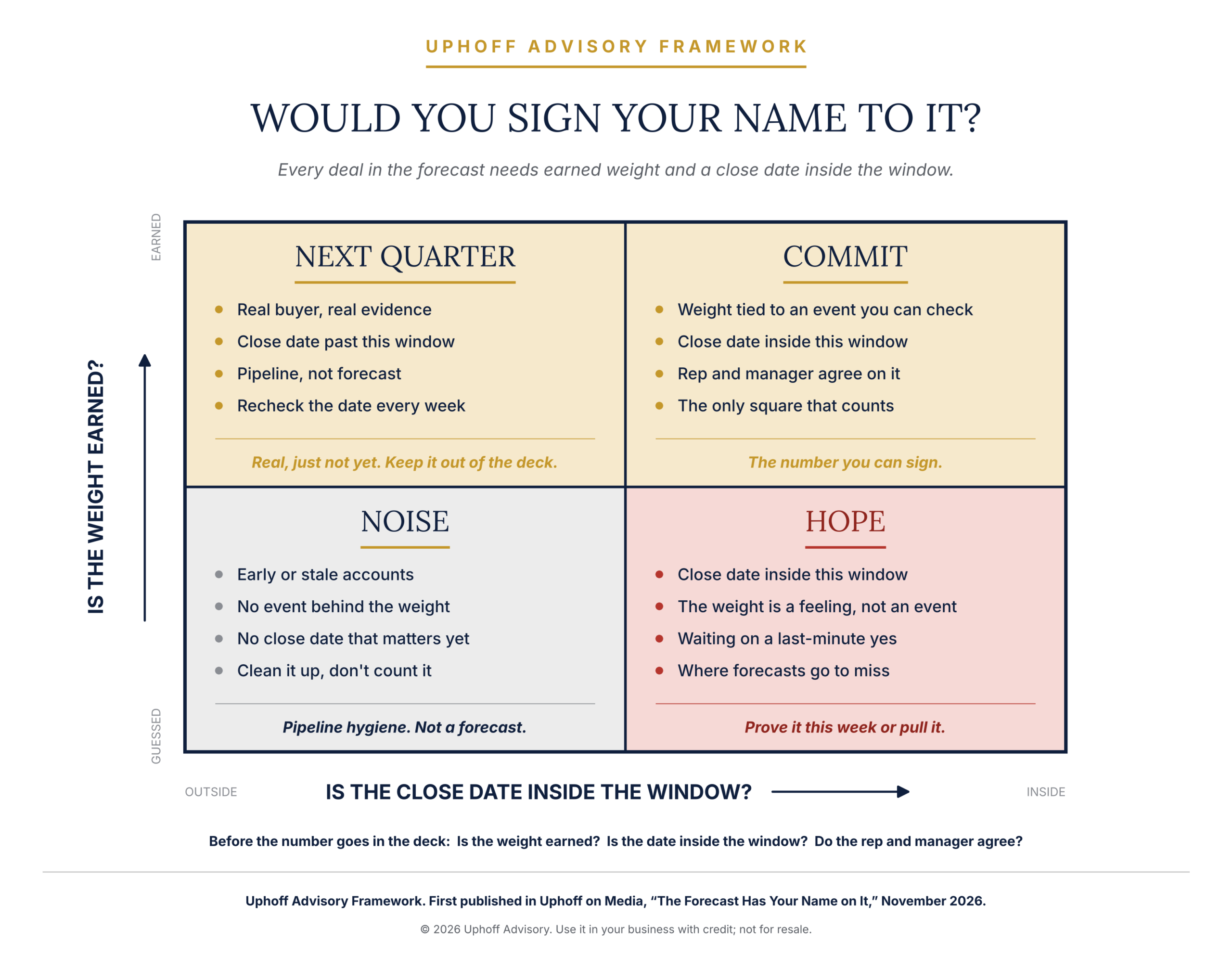
A pipeline forecast framework: two questions sort every deal into Commit, Next Quarter, Hope or Noise. Only one square belongs in the number you report.
A pipeline forecast only works when pipeline and forecast stay two different numbers. Pipeline is what could close. Forecast is what will close inside a defined window. A deal belongs in the forecast only when its weight is earned by an event you can check and its expected close date falls inside the window. Everything else is pipeline.
This month or this quarter: the period the number you report covers.
A verbal commitment, a confirmed proposal, a reply from the decision makers. No event, no earned weight.
Inside the window or outside it, whatever the weight.
Commit, Next Quarter, Hope or Noise.
Prove each of those deals this week or pull it from the forecast.
Before the number goes in the deck, do the rep and the manager agree on each Commit deal, and would you sign your name to it?
Commit: earned weight, inside the window, the only square that belongs in the forecast. Next Quarter: earned weight, outside the window, real pipeline but not this window’s number. Hope: inside the window, but the weight is a feeling, not an event; this is where forecasts miss. Noise: neither earned nor inside the window; pipeline hygiene, not forecast.
Pipeline is everything that could close. Forecast is what will close inside a defined window. Pipeline is always the bigger number, and reporting it as the forecast is how repeat misses happen.
An event you can verify: a verbal commitment waiting on signature, a confirmed proposal the buyer is working through, decision makers who have engaged back. A rep’s read on how the call went is not an event.
Its deals sit inside the window, so they look like forecast. Their weight rests on hope rather than evidence, so they are the deals most likely to slip in the last weeks of the quarter.
Record both numbers and the gap. Over several weeks the gap shows which reps run optimistic and which run conservative, which is a read on judgment.
Weekly, in the sales leader’s forecast review with each rep, and again before any number goes to a board.
Related: The Four Numbers; The Three-Case Model
Would You Sign Your Name to It? is an Uphoff Advisory Framework created by Tony Uphoff, five-time B2B CEO and founder of Uphoff Advisory, first published in Uphoff on Media on November 11, 2026.