The Three Eras of Data Moats
Aggregation, workflow, agentic. What customers paid for in each era, where the moat lived, what put it at risk, and what the vendor has to own now.
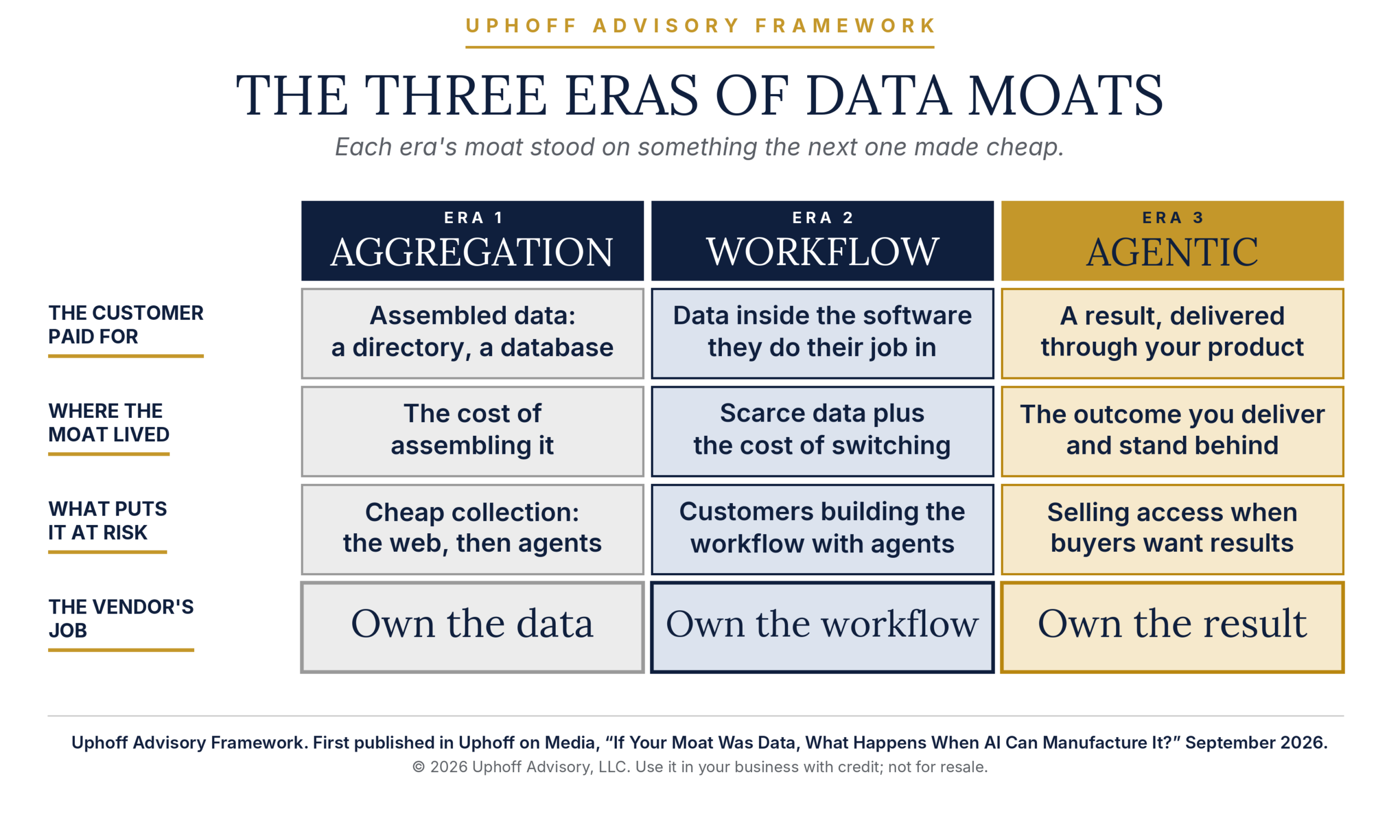
Aggregation, workflow, agentic. What customers paid for in each era, where the moat lived, what put it at risk, and what the vendor has to own now.
The Three Eras of Data Moats traces how data businesses have defended their value across three eras: aggregation, workflow and agentic. For each era it shows what customers paid for, where the moat lived, what put it at risk and what the vendor’s job was. In the agentic era, however, the vendor has to own the result, not just the data.
Data moats have always stood on something the next era made cheap. In aggregation, the moat was the cost of assembling the data; now, agents assemble facts from public sources for close to nothing. In workflow, it was scarce data plus the cost of switching; meanwhile, customers can use agents to build that workflow themselves. Today, in the agentic era, the moat is the outcome you deliver and stand behind.
Assembled data, data inside the software they do their job in, or a result delivered through your product.
The cost of assembling the data, the cost of switching away from your workflow, or the outcome you deliver.
Cheap collection by the web and then agents, customers building the workflow with agents, or selling access when buyers want results.
From owning the data, to owning the workflow, to owning the result. Design the product so customers’ agents can run on your data and your accountability.
Aggregation, workflow and agentic.
The result. Data and software become inputs, and customers pay for a measurable outcome someone delivers and stands behind.
Related: The Data Moat Test · The Durability Test
The Three Eras of Data Moats is an Uphoff Advisory Framework created by Tony Uphoff, five-time B2B CEO and founder of Uphoff Advisory, first published in Uphoff on Media on September 21, 2026. Read the full piece: If Your Moat Was Data, What Happens When AI Can Manufacture It?