Who Holds the Pen, Who Holds the Risk
A five-stage governance check for co-marketing, partner and creator content: who holds creative control at each stage, and who carries the risk.
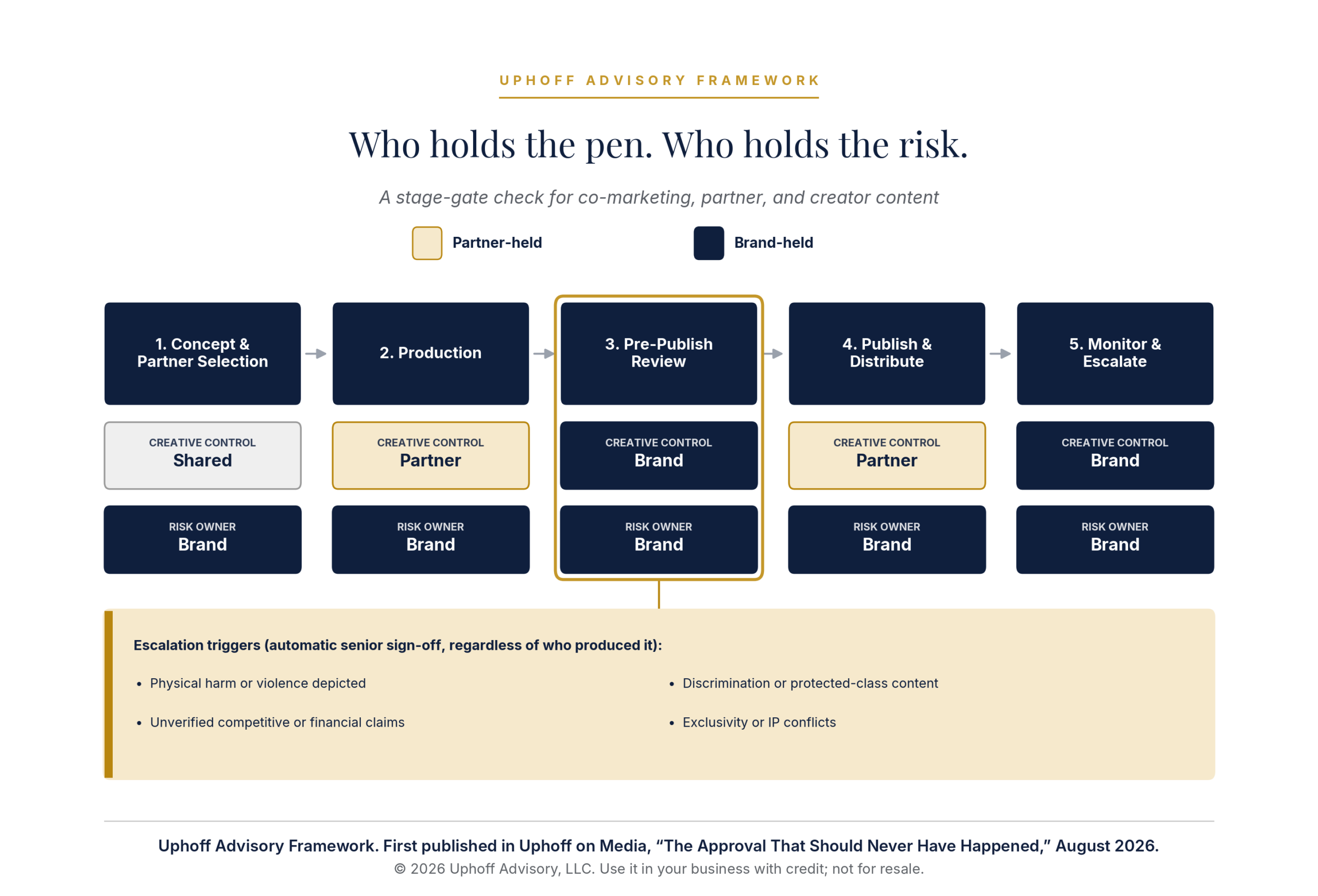
A five-stage governance check for co-marketing, partner and creator content: who holds creative control at each stage, and who carries the risk.
Who Holds the Pen, Who Holds the Risk is a co-marketing approval process in five stages, for partner and creator content as well as co-marketing: concept and partner selection, production, pre-publish review, publish and distribute, and monitor and escalate. At each stage it names who holds creative control and who owns the risk if something goes wrong. Those two answers are almost never the same name. Creative control moves between the partner and the brand. The risk stays with the brand at every stage.
In any co-marketing approval process, the gap matters most at pre-publish review, because that is where the veto lives. The person holding it needs both the authority to stop a piece and the incentive to use it. When a partner is driving growth, the reviewer often has the first and not the second. In consumer brands the fallout is public. In B2B it is quieter: a stalled deal, a shortlist invitation that never arrives, and nobody names the cause.
The exposure is growing. Partner-sourced revenue is now roughly 24% of new bookings in horizontal SaaS, according to a 2026 Crossbeam and Partnership Leaders survey of more than 2,100 vendors. AI-generated content adds a faster source with an unclear veto owner. More of what goes out under your name is produced by someone else.
Take a current co-marketing, sponsored or creator program and write down who actually holds creative control at each stage, by name.
Write down who carries the fallout if the content goes wrong. If the answer is the brand at every stage, the review step has to carry real weight.
The pre-publish reviewer needs the authority to stop a piece and no stake in the partner’s growth numbers.
Physical harm or violence, discrimination or protected-class content, unverified competitive or financial claims, and exclusivity or IP conflicts go to senior sign-off, regardless of who produced the piece or how well the partnership is performing.
Concept and partner selection, production, pre-publish review, publish and distribute, and monitor and escalate.
Anything depicting physical harm or violence, anything touching discrimination or a protected class, any unverified competitive or financial claim, and any conflict with an exclusivity or IP commitment.
Yes. AI adds a faster source of content with an unclear veto owner, which widens the gap between who holds the pen and who holds the risk.
Related: The Narrative Index · The Signal-Honesty Spectrum · Discoverable Is Not Recommended
Who Holds the Pen, Who Holds the Risk is an Uphoff Advisory Framework created by Tony Uphoff, five-time B2B CEO and founder of Uphoff Advisory, first published in Uphoff on Media on August 28, 2026. Read the full piece: The Approval That Should Never Have Happened