The Three-Case Model
Plan a range, not a number. A 10 to 15 percent variance band turns a shortfall into an update instead of a surprise.
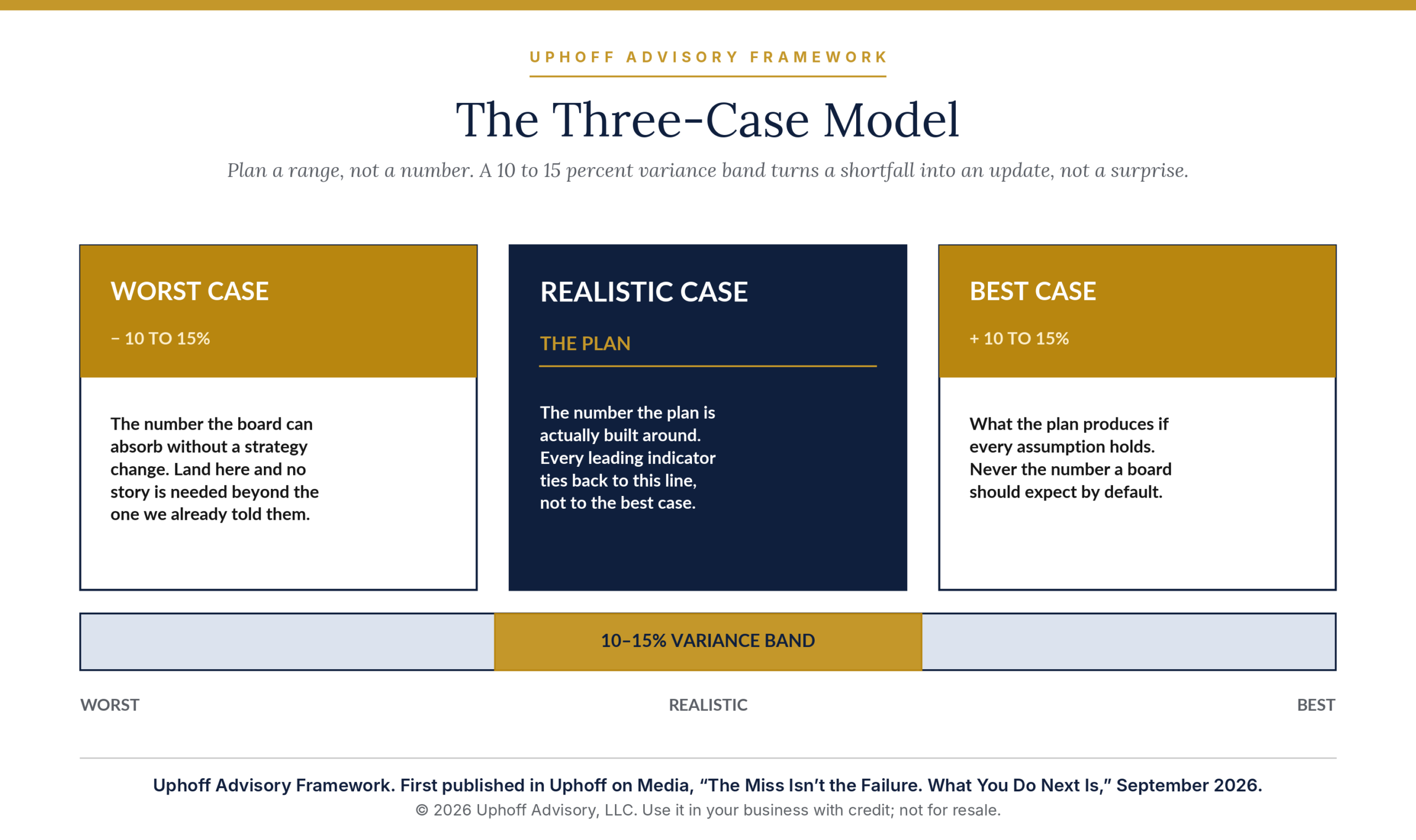
Plan a range, not a number. A 10 to 15 percent variance band turns a shortfall into an update instead of a surprise.
The Three-Case Model replaces a single forecast number with a range: a worst case, a realistic case and a best case, inside a 10 to 15 percent variance band. The realistic case is the plan, the number every leading indicator ties back to. The band turns a shortfall into an update the board has already seen, not a surprise.
Run the business against the range every week, and a shortfall shows up as a trend line long before it shows up in a board deck. That gives you time to act on it. A board that has already seen the worst case in writing doesn’t treat a miss as a betrayal.
This is the plan: the number the business is actually run around. Tie every leading indicator to this line, not to the best case.
The number the board can absorb without a strategy change, 10 to 15 percent below the plan.
What the plan produces if every assumption holds, 10 to 15 percent above. Never the number a board should expect by default.
Compare actual and projected results to all three cases as the quarter unfolds, not after it closes. A trend toward the worst case is the signal to build a Bridge Plan.
Name the realistic case as the plan, so a result inside the band reads as an update.
A 10 to 15 percent band on either side of the realistic case.
That is a miss, not a variance. Diagnose it with the Miss Diagnostic before deciding what to do, then build a Bridge Plan back to budget.
Related: The Miss Diagnostic · The Bridge Plan · The Goals-to-Systems Flywheel
The Three-Case Model is an Uphoff Advisory Framework created by Tony Uphoff, five-time B2B CEO and founder of Uphoff Advisory, first published in Uphoff on Media on September 8, 2026. Read the full piece: The Miss Isn’t the Failure. What You Do Next Is