The 3 Ps: Positioning, Packaging and Pricing
Three decisions no machine can make for you. Run any offer through positioning, packaging and pricing, in that order, and test it against the AI agent and the buying committee.
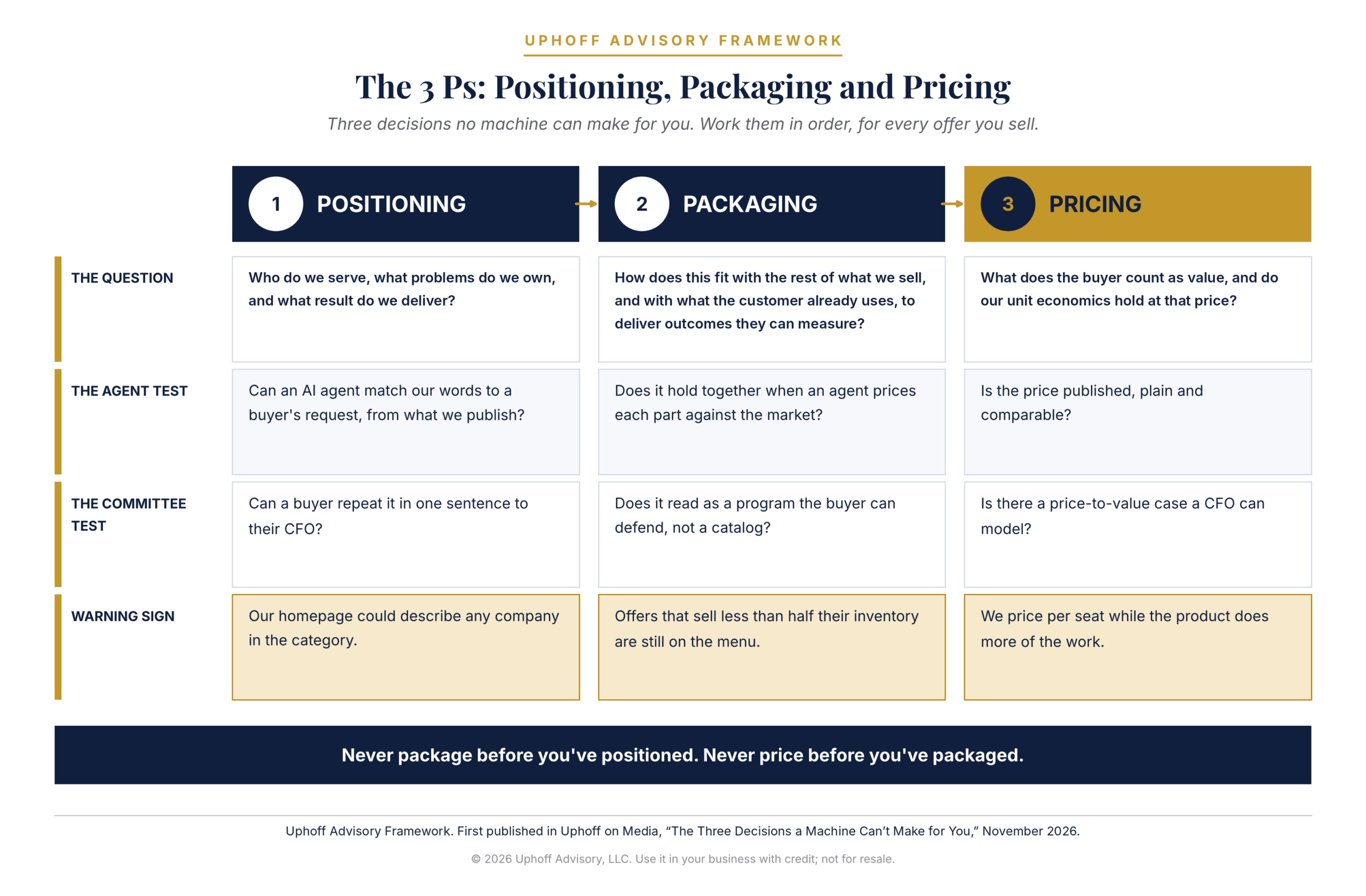
Three decisions no machine can make for you. Run any offer through positioning, packaging and pricing, in that order, and test it against the AI agent and the buying committee.
Positioning, packaging and pricing matter more now because AI made B2B products cheaper to build and easier to compare. As a result, the value moved into three decisions no machine can make for you: who you serve, what you bundle and what you charge. They are also harder to get right. That’s because every B2B company now sells to two buyers at once. One is an AI agent that shortlists vendors pass or fail. The other is a buying committee that has to defend the choice. So work them in order: never package before you’ve positioned, and never price before you’ve packaged.
Pick one offer you sell today.
Answer who you serve, what problems you own and what result you deliver, in words an AI agent can match to a buyer’s request.
Decide how the offer fits with the rest of what you sell, and with what the customer already uses, to deliver outcomes they can measure.
Name what the buyer counts as value, then check that your unit economics hold at that price.
Check each answer against the agent test: can an AI agent read and compare it? Then apply the committee test: can the buying committee defend it to the CFO?
Fix the earliest warning sign first. Never package before you’ve positioned, and never price before you’ve packaged.
Because each decision depends on the one before it. You can’t package around a promise you haven’t made. Likewise, you can’t price a result you haven’t claimed.
Seat pricing assumes a human does the work and the software helps. When an agent does the work, however, the number of seats shrinks while the value delivered goes up. As a result, a price built on seats falls just as the product gets better.
For digital media and marketing products, the test is simple. An ad, sponsorship or lead-generation product earns its place on the rate card when it sells at least half of its available inventory. Below that, fold it into a program or retire it.
Yes. For example, in Tony Uphoff’s own operating record, moving Thomasnet from à la carte to solution pricing raised the average sale by 40%. Similarly, a single-price Branded Demand program at Pipeline360 lifted order size and retention.
Uphoff Advisory uses Buying Committee Modeling. AI personas for each seat on a B2B buying committee react to the offer as a buyer would find it, along with an agent that stands in for the buyer’s AI. However, the modeling doesn’t predict who will buy. Instead, it shows where positioning, packaging and pricing are working and where they aren’t. It also validates the ideal customer profile.
More often than you think. For example, a competitor can match a package in a quarter and undercut a price in a week. So the advantage goes to whoever revisits the three decisions most often.
Related: The Price-to-Value Map; The Judgment Lever; Solo Scale and Team Scale
The 3 Ps is an Uphoff Advisory Framework created by Tony Uphoff, five-time B2B CEO and founder of Uphoff Advisory, first published in Uphoff on Media on November 4, 2026.